Bourdon Manometer Explained: A UK Buyer's Guide
A bourdon manometer is a mechanical pressure gauge that measures pressure using a curved metal tube, known as a Bourdon tube, which moves as pressure changes and turns a pointer on a dial. In the UK, bourdon manometers are widely used for boilers, compressors, pumps and process systems because they are robust, simple and do not need a power supply.
TL;DR: A bourdon manometer is best for reliable visual press indication on general industrial systems, especially at medium and higher pressures. However, for low-pressure gas testing, HVAC commissioning and fault-finding where fine resolution matters, a digital manometer is often the better choice. In practice, the right option depends on pressure range, accuracy needs, environment and compliance requirements — and if you are the engineer still carrying a bulky analogue gauge into cramped boiler cupboards, a pocket digital manometer you simply press ZERO on and read straight off in mbar is usually easier day to day.
For UK engineers, heating professionals and facilities teams, that choice matters because accuracy, durability and ease of reading all affect site diagnostics. At Manompress, we focus on fast, accurate pressure testing with compact digital instruments built for trade work, particularly where low-pressure gas and HVAC checks demand clear readings and quick set-up. Therefore, when comparing a traditional bourdon manometer with modern test equipment, practical application should come first.
This guide explains what a bourdon manometer is, how it works, where it performs well, where its limits appear and what UK buyers should check before purchasing.
Key Takeaways
- A bourdon manometer measures pressure mechanically using a curved metal tube that moves as pressure changes.
- It remains common across UK industry because it is durable, easy to read and requires no external power.
- It is generally less suitable for fine low-pressure diagnostics where digital resolution or differential measurement is needed.
- For HVAC commissioning, gas tightness checks and low-pressure fault-finding, a compact digital manometer often provides quicker and more precise readings.
- Before buying, check the pressure range, accuracy class, wetted materials, dial size, mounting arrangement and calibration support.
What Is a Bourdon Manometer?
A bourdon manometer is a mechanical instrument used to measure pressure. It works by using the elastic movement of a curved metal tube to indicate pressure on an analogue dial. In practice, many engineers also call it a Bourdon tube gauge.
It is commonly fitted to pumps, compressors, boilers, hydraulic systems and process equipment across Britain. When pressure enters the tube, the tube tries to straighten slightly. That movement is transferred through linkages to a pointer on the gauge face, giving a direct visual reading without batteries or mains power.
The design dates back to the nineteenth century and still remains popular because it solves a basic engineering problem reliably. A properly selected bourdon manometer can give years of service when it is correctly installed, protected from overpressure and checked during routine inspection and calibration intervals.
How Does a Bourdon Manometer Work?
What Is the Bourdon Tube Principle?
The key component is the Bourdon tube: a flattened metal tube formed into a C-shape, spiral or helix. One end is fixed to the pressure connection while the other end is sealed but free to move.
As internal pressure rises, the cross-section of the tube tends to become more circular. As a result, the curved tube uncurls very slightly. This small movement drives mechanical linkages and gears that rotate the pointer across a calibrated dial.
What Does the Dial Read On a Bourdon Manometer?
The dial may be marked in bar, psi, kPa or mbar depending on the intended application. In UK specifications, bar and mbar are commonly used for many building services and industrial duties, although psi still appears on older plant and imported machinery.
For quick visual checks on higher-pressure systems, this format works well. However, for fine diagnosis at lower pressures where very small changes matter, an analogue pointer can be harder to interpret than a digital display.
What Types of Bourdon Manometer Are Available?
- C-type Bourdon gauges: widely used for general industrial duties.
- Helical or spiral types: often suited to larger movement ranges or higher pressures.
- Dry gauges: common for standard indoor installations.
- Liquid-filled gauges: designed to reduce pointer flutter in vibrating environments.
- Gauge pressure instruments: measure relative to atmospheric pressure.
- Absolute or compound variants: available for specialist applications including vacuum ranges.
Where Are Bourdon Manometers Used in the UK?
Bourdon manometers are used wherever straightforward line press indication is needed. In the UK that includes manufacturing plants, commercial heating systems, water treatment works, food production lines and engineering workshops.
You will also find them on OEM machinery from British and European manufacturers where operators need an immediate reading at the point of use. Because they are economical and familiar to maintenance teams, they remain common across fixed plant installations.
What Are Common Applications for a Bourdon Manometer?
- Boiler and steam systems
- Compressed air installations
- Pump skids and water systems
- Hydraulic machinery
- Chemical process lines
- General plant monitoring
NHS estates environments also depend on dependable pressure monitoring across HVAC services and building plant. Even so, service engineers often prefer digital instruments during commissioning or troubleshooting because they can provide more precise readings at lower ranges.
What Are the Advantages of a Bourdon Manometer?
Why Is No Power Supply an Advantage?
A bourdon manometer works mechanically rather than electronically. Therefore, it suits fixed installations where local indication is required without wiring, charging or battery replacement.
How Durable Is a Bourdon Manometer?
A well-made gauge with suitable case construction and wetted materials can perform reliably in demanding conditions. Stainless steel versions are often chosen in British industry where corrosion resistance or washdown conditions are important.
Why Are They Cost-Effective for General Monitoring?
If you need basic visual confirmation of line pressure rather than fine diagnostic detail, analogue gauges are often cost-effective when installed across several points in one system.
Easily Understood on Site
The display format is familiar to most technicians. Consequently, a quick glance at needle position can show whether equipment appears within its normal operating range without changing settings or navigating menus.
Are Bourdon Manometers Suitable Across Broad Pressure Ranges?
Bourdon designs are especially suitable for medium- and high-pressure duties that would be less practical for some alternative mechanical principles intended mainly for very low pressures.
What Are the Limitations of a Bourdon Manometer?
Are Bourdon Manometers Accurate Enough for Low-Pressure Work?
This is where many buyers choose the wrong instrument. A bourdon manometer may be entirely suitable for general system monitoring yet poorly suited to low-pressure gas testing or fine HVAC diagnostics. At very low pressures, small pointer movements can be difficult to interpret accurately, especially in poor lighting or awkward access positions.
Can Vibration Affect Readings?
Yes, vibration can make readings harder to read by causing pointer flutter. Although liquid-filled gauges can help, heavy vibration still affects usability over time and may influence wear within the movement mechanism.
Do They Need Calibration and Inspection?
Yes. While they are simple instruments, they still require periodic inspection, especially where readings influence safety, compliance or maintenance decisions. Any gauge used for critical checks should be verified against traceable standards at suitable intervals.
Are They Ideal for Differential Pressure Measurement?
No, not usually. A standard bourdon manometer reads single-point line pressure rather than small differential changes between two points. Therefore, applications such as airflow proving, combustion setup or detailed gas tightness investigation often favour dedicated digital devices.
Bourdon Manometer vs Digital Manometer: Which Is Better?
The better instrument depends on your task rather than tradition alone. A bourdon manometer is excellent for permanent visual indication on general plant. By contrast, digital manometers are typically better when you need fine resolution, data stability, differential readings or quick diagnostics in tight spaces.
When Should You Choose a Bourdon Manometer?
- When you want simple local indication with no power requirement
- When system pressures are medium or high rather than very low
- When operators need an immediate analogue view of plant condition
- When permanent installation cost needs to stay reasonable
When Is a Digital Manometer Better?
- When measuring low-pressure gas in mbar
- When carrying out commissioning or fault-finding on HVAC systems
- When differential readings are required
- When clear numerical resolution matters more than rough needle position
- When test speed, portability and readability are priorities on site
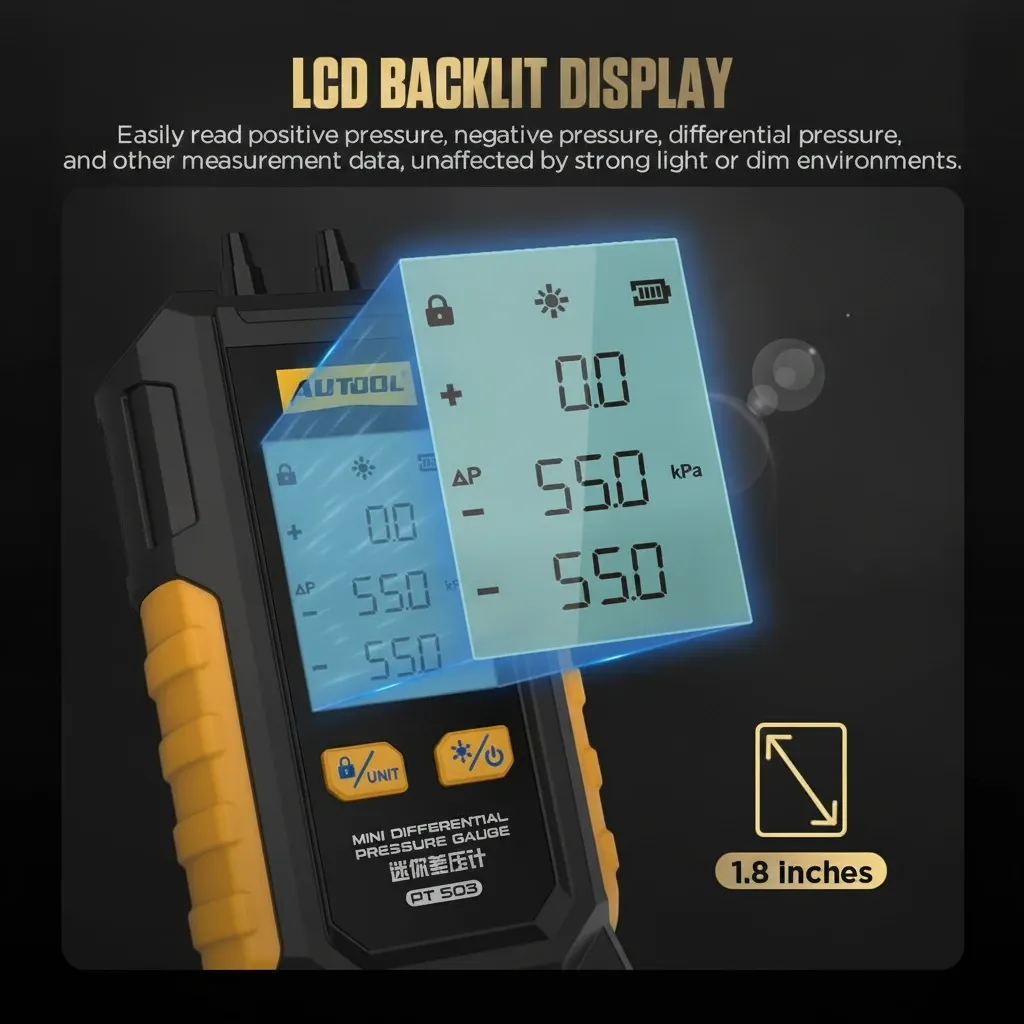
In practice, compact digital instruments usually offer faster setup, clearer interpretation and better confidence during low-pressure service work. You get a numeric mbar reading at a glance instead of squinting at a needle at an awkward angle in a poorly lit cupboard, and one unit switches between mbar, kPa and psi so there is no manual conversion. For gas and HVAC diagnostics, see our Manompress mini digital manometer. That said, they do not replace every installed analogue gauge on fixed plant.
How Do You Choose the Right Bourdon Manometer?
What Pressure Range Should You Select?
Choose a gauge whose normal operating pressure sits comfortably within its scale rather than constantly near maximum. This helps readability and reduces stress from overrange conditions.
What Accuracy Class Do You Need?
Check whether the gauge accuracy matches your task. For general indication, standard industrial classes may be acceptable. For verification work or compliance-related measurement, tighter accuracy may be necessary.
Which Materials Matter?
Consider case material, connection material and wetted parts based on media compatibility and environment. For example, stainless steel may be preferable in damp plant rooms or corrosive settings.
Does Dial Size Affect Readability?
Yes. Larger dials usually improve readability from distance or awkward angles. In contrast, small compact gauges suit tighter spaces but can be harder to read precisely.
What Mounting Style Is Best?
Common options include bottom entry, back entry, panel mount and surface mount arrangements. The best choice depends on access, pipework layout and whether the gauge will be read from front or side positions.
Should You Check Calibration Support?
Absolutely. Before buying, confirm whether calibration certificates, replacements and ongoing support are available in the UK. This matters more where documentation forms part of quality assurance or planned maintenance records.
What Should UK Buyers Know About Standards and Compliance?
In Britain, buyers should consider not only performance but also suitability for the environment and task. Where gauges form part of regulated systems or documented maintenance processes, traceability and correct specification become especially important.
Buyers should review factors such as material compatibility, operating temperature, vibration exposure, overpressure protection and calibration intervals before installation. For gas work and building services diagnostics, always use instruments appropriate to the test procedure being carried out and follow current manufacturer instructions as well as relevant site rules.
Frequently Asked Questions About Bourdon Manometers
What is the difference between a Bourdon gauge and a digital manometer?
A Bourdon gauge gives an analogue mechanical reading without power, whereas a digital manometer shows electronic numerical readings and often offers higher resolution for low-pressure or differential work.
Is a Bourdon manometer good for gas pressure testing?
It can be used for some general press indications, but for low-pressure gas testing in mbar, many engineers prefer a digital instrument because it provides finer resolution and easier reading.
Do Bourdon manometers need calibration?
Yes. If the reading influences safety, diagnosis or maintenance records, periodic calibration or verification against traceable standards is recommended as part of good engineering practice in the UK.
What are the main disadvantages of a Bourdon manometer?
The main drawbacks are limited readability at very low pressures, reduced suitability for differential measurements and potential difficulty reading fine changes compared with digital displays.
Final Verdict: Is a Bourdon Manometer Right for You?
If you need dependable, local mechanical indication on general industrial equipment, a bourdon manometer remains an excellent choice. It is proven, widely understood and well suited to many fixed installations across the UK.
However, if your work involves low-pressure gas checks, HVAC commissioning or detailed fault-finding, a compact digital manometer may deliver better precision and quicker decision-making on site. At Manompress, our practical view is simple: choose the instrument that best fits the job, not just the most familiar design. Shop the Manompress mini digital manometer for trade-grade differential testing.
Ready to upgrade your toolkit with Manompress?
Shop Now — £48.73